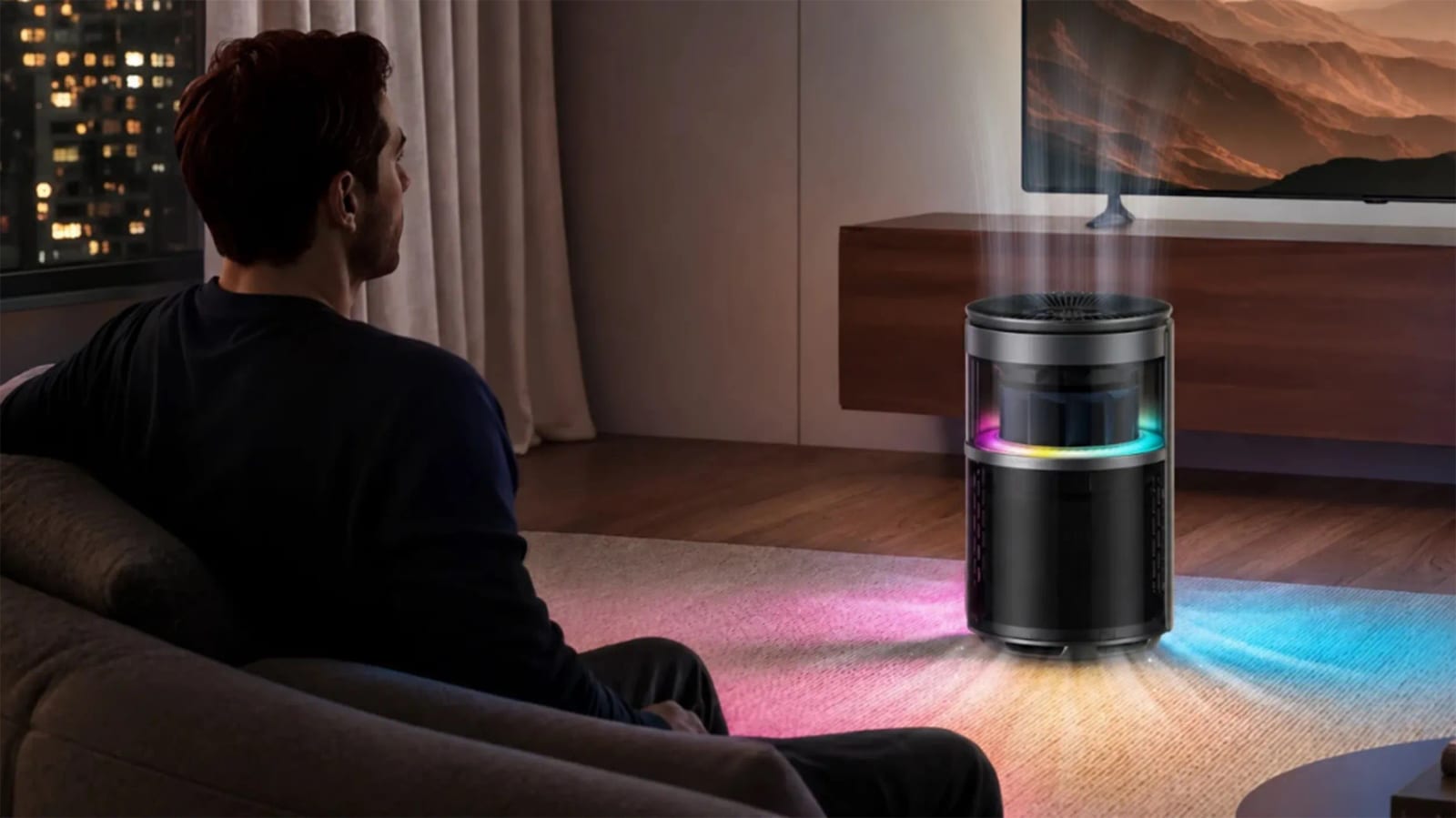
Air conditioners that track where you sit and aim cool air at you are arriving from Samsung, LG, Midea, Hisense and others. Makers say this saves power. Samsung claims up to 30 percent and Midea says more than 30 percent. Both numbers come from the companies' own claims, and an outside expert says the real gains may be modest.
What these units do
Radar sensors detect people in a room and steer airflow toward them. LG's DualCool AI AC has a 5-meter radar sensor and learns your daily movement patterns. Samsung's WindFree Pro can track two people. Hisense's Companion Living AC uses smart home sensor data to cool the paths you usually walk, such as couch to kitchen, before you get up.
Midea's VitaBreeze, due in early 2027, asks you to upload photos of your room. It combines them with radar to build a 3D map and adjusts its vents as you move.
What the savings claims really say
Samsung's figure comes from its own residential environment tests, with its AI energy mode switched on. Midea's executive says its technology saves more than 30 percent compared with units without these algorithms. Neither number comes from an independent test in the material reviewed.
Björn Palm, an energy technology professor at KTH Royal Institute of Technology in Stockholm, says the idea has potential to reduce energy use. How much is less clear.
Why one expert is doubtful
Vincent Romanin, founder of window AC maker Gradient, says targeted cooling can help if done well. But he notes that newer buildings are already cutting energy use by 85 percent. Adding a feature that gets to 87 percent, he says, is not much. He also says he has never used an occupancy sensor product that worked well.
Efficiency is improving on its own. The average AC sold in 2024 was about 20 percent more efficient than an equivalent 2014 model.
Privacy and what to do
Dyson's Find+Follow fan uses a low-resolution camera. It turns people into anonymous stick-figure points, processes them on the device and deletes them. It does no face recognition. Other makers' data handling is not detailed in the material.
- Treat big savings numbers as maker tests, not guarantees.
- Check the unit's basic efficiency rating first.
- Ask what the sensor records and where the data goes.
Why the stakes are high
Air conditioners and electric fans use around 20 percent of electricity in buildings worldwide. The number of AC units in use could reach 5.5 billion by 2050. Palm says cheaper, compact heat pumps will matter more than smarter airflow.
The takeawayRadar-guided cooling may help comfort, but judge an AC by its basic efficiency, not by a maker's up-to-30-percent claim.