A bigger battery is not what makes a phone charge slowly. In a month of timing a Google Pixel 8, an Android Police writer found that the charger, the port and the phone's own limits matter far more. The phone has a 4,575 mAh battery and tops out at 27 watts of wired charging. Plenty of chargers can hit that. The wrong one can barely move the needle.
The charger has to speak the phone's language
Fast charging depends on the phone and charger agreeing on a speed. The Pixel 8 does this over USB Power Delivery, a common standard that lets the two negotiate power. A USB-A charger built around Infinix's own fast mode, with no Power Delivery support, added just 1% in three minutes. The Pixel's Tensor G3 chip also does not support Qualcomm's Quick Charge, so that standard falls back to slow charging.
Only USB-C ports can do the Power Delivery handshake. A USB-A port is stuck with older, slower modes.
Why the last stretch drags
Charging is fastest at low and middle levels. In one test, with a 65W adapter and a 240W cable, the phone went from 56% to 80% in 18 minutes. Going from 80% to 88% took 12 minutes. By 92%, it was adding less than 1% a minute, about a third of its starting pace.
Some of this is on purpose. Battery protection and heat management slow charging to keep the battery healthy. Near full, the charger barely matters.
You may not need a pricey charger
The Pixel 8 draws at most 27W, and almost any decent USB-C charger supplies that. A $100 charger often pays for extras, such as higher outputs meant for laptops, more ports and a brand name. Cheap, unknown adapters carry their own risk, since fakes can overheat or damage a battery. The Pixel does not ship with a charger, only a 1-meter USB-C cable.
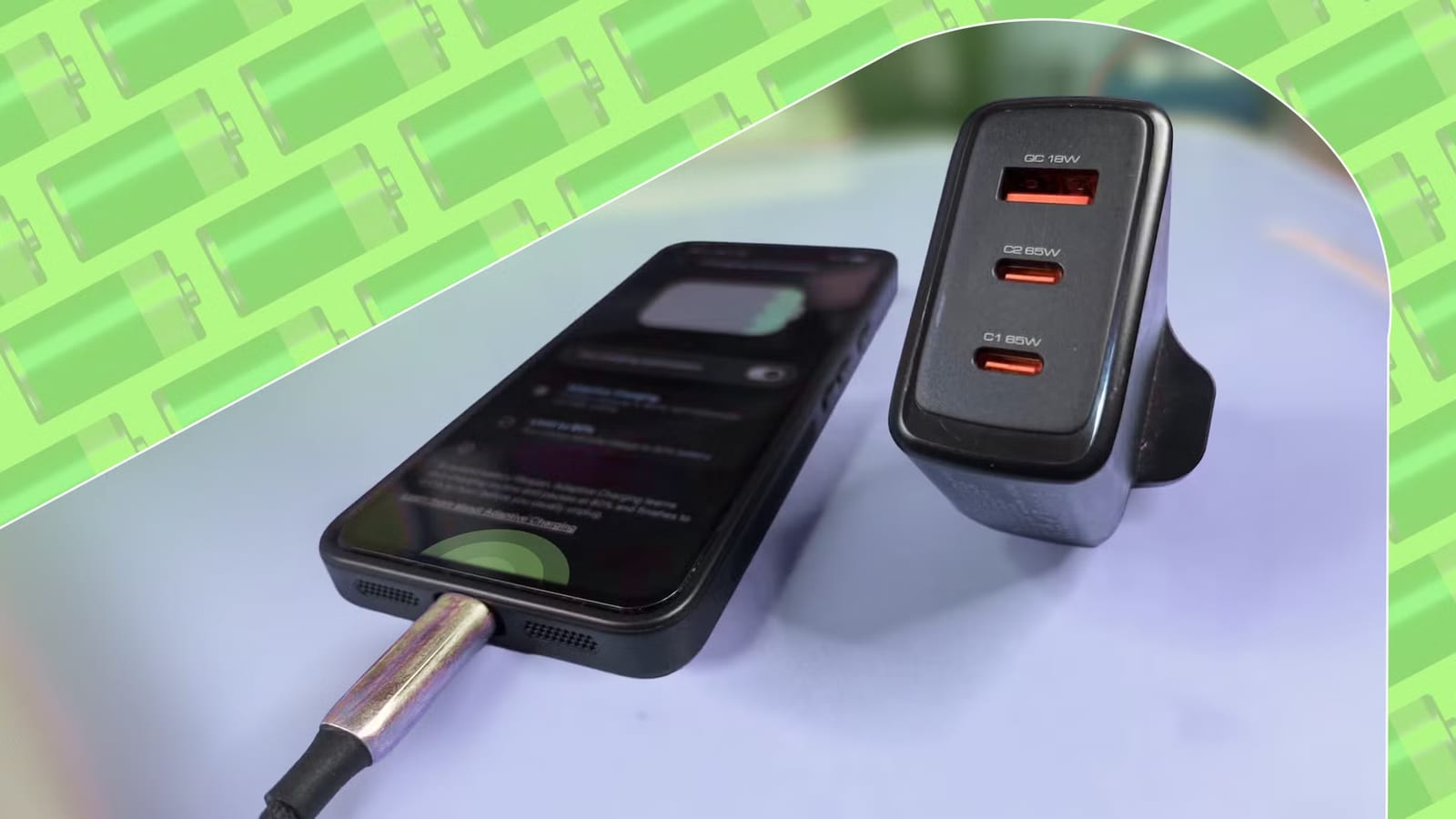
Multiport chargers add a catch. They split power between ports. On the tested 65W unit, using two USB-C ports gave 45W and 20W. Using the second USB-C port and the USB-A port together dropped both to 12W, less than half of what the Pixel can take.
What to do
- Check which fast-charging standard your phone supports before buying a charger.
- Use a USB-C port, and plug your phone into the highest-power port on a multiport charger.
- Take the phone out of its case while it charges.
- Keep it off beds and pillows and out of direct sun, which build up heat.
- Unplug around 80% if time matters.
Average tests with a 30W adapter put the Pixel 8's full charge at about 1 hour 23 minutes. The sweet spot is between 20% and 80%.
The takeawayMatch the charger to your phone's standard, use a USB-C port, keep the phone cool and unplug near 80% instead of paying for a bigger charger.