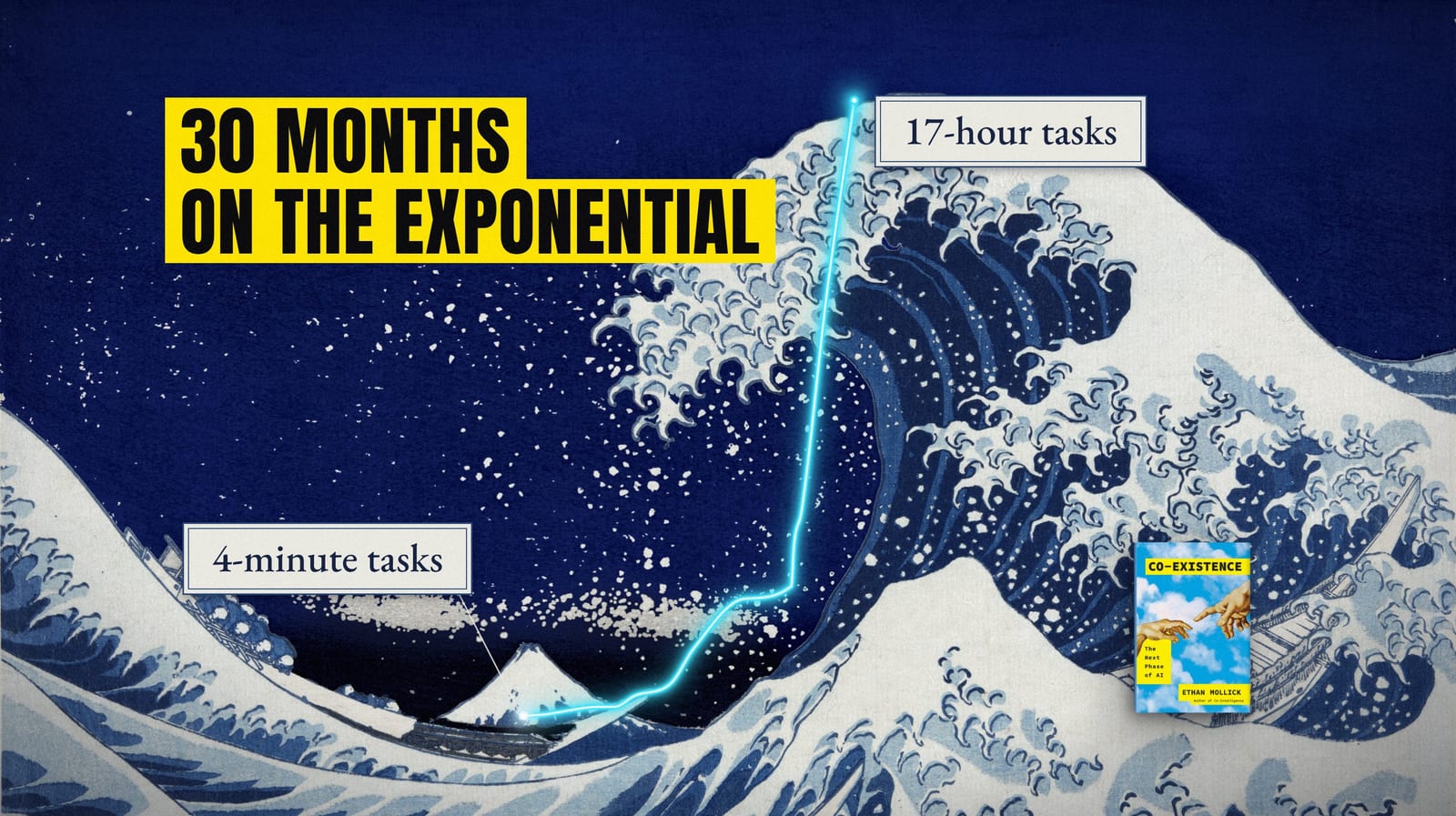
AI can now handle a job that would take a person 17 hours, starting from a single request. That is the finding Ethan Mollick, a writer who follows AI closely, highlights as his second book, Co-Existence, comes out. In 2024, the same kind of test showed AI handling a task of about four minutes. The measure counts jobs the AI finishes with at least a 50% chance of success.
What changed
The numbers come from a test by a group called METR. From the release of GPT-4 to the end of that measure, the amount of work AI could do doubled eight times. In April 2026, it reached 17 hours. METR has said it can no longer measure this accurately with its current methods. Other studies suggest the figure could be 17 weeks of work, or more.
Cheaper and everywhere
Prices fell as ability rose. A graduate-level exam that regularly stumps graduate students once cost 30 cents in AI usage to get one correct answer. Now it costs four hundredths of a cent.
The field has also widened. GPT-4 was the clear best model from early 2023 to early 2024. Since then, twenty different models have held the lead, all from Anthropic, Google or OpenAI.
- 180 models now beat GPT-4 as it was at release.
- Many are open weights, meaning anyone may use or modify them.
- Nineteen can run on a modern smartphone.
A new way of working
Mollick used the charts in his post as an example. He gave an AI system a couple of sentences of suggestions. It then did research, graphing, layouts, images and citations in minutes, work he says would have taken hours. It also caught a math error of his. He had planned to title the post 28 months, not 30.
He calls this style of work the conjurer. A person summons AI agents, assigns work and checks what comes back. He describes it as the most powerful way to use AI, but one with new risks, because people lose sight of exactly how the AI reaches its results.
Where AI still falls short
Progress is uneven. AI is still quite a bad long-form writer, according to Mollick. Math problems, on the other hand, went from terrible to superhuman in the same period. Even where AI is excellent, he writes, small gaps create large needs for humans, at least for now.
What to do
Tasks once split into small steps can now often be handed off whole. Trying AI on a bigger job, such as a full report draft or a research task, shows what it can do today. Plan time to check the result, since the AI may take steps the user never sees.
The takeawayTry handing AI a whole job instead of small steps, then check the result carefully before relying on it.