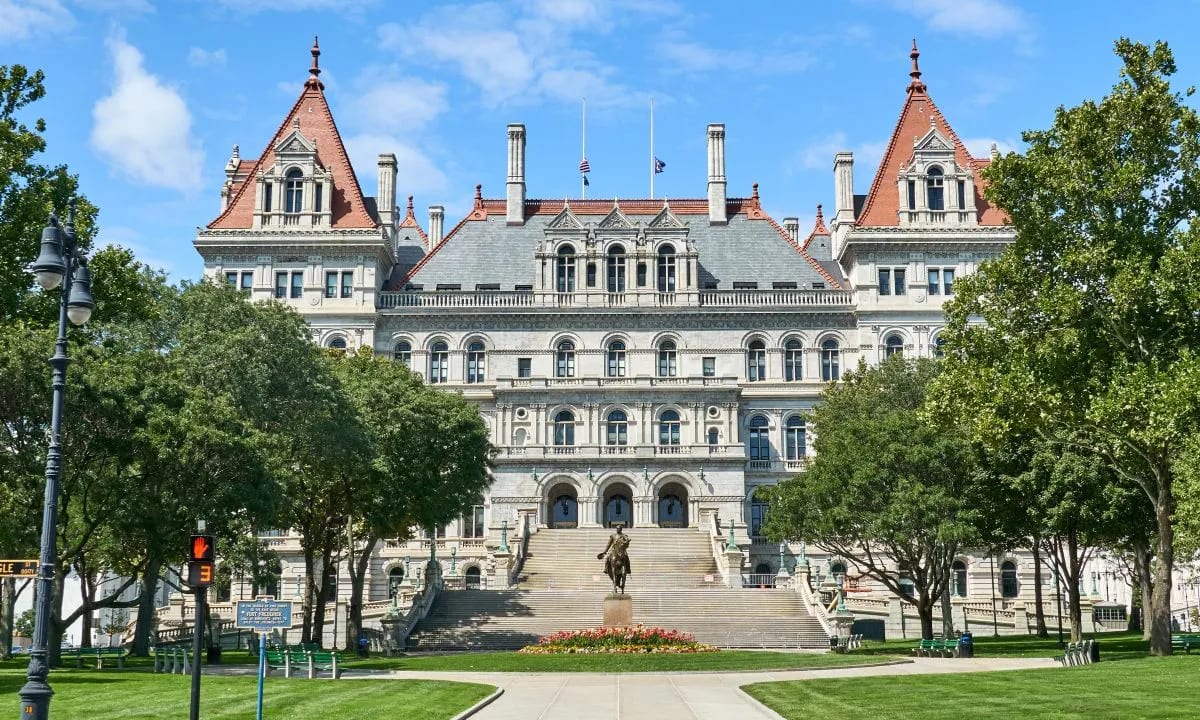
Two New York lawmakers want the state's biggest AI companies to be checked by outside experts, not just their own staff. State Sen. Andrew Gounardes of Brooklyn and Assemblymember Jordan Wright of Harlem introduced the bill on Thursday, Oct. 29. It builds on the RAISE Act, the state's AI safety law, which passed a year ago.
What the bill would do
The RAISE Act only requires AI developers to disclose their safety plans. The new bill goes further. Large developers would have to hire an independent, state-licensed examiner, called a "frontier examiner." That person would run yearly audits of whether the company follows its own safety plans. The examiner would also do broader safety reviews and assess the risk of catastrophic harm every 90 days.
- Quarterly reports on how much of a company's AI research is automated, and how it uses its computing power.
- A report within 72 hours of any substantial jump in risk or in the ability to automate AI research.
- Power for a new state office, DIGIT, to limit the computing power used to train new models.
- Power for the Attorney General to ask a court to halt dangerous activity, including limiting a model's use in New York.
Why the bank comparison
PYMNTS notes the examiner idea works much like bank supervision. In banking, outside auditors review an institution's governance, risk controls and fixes. With a stronger DIGIT office, AI oversight in New York would take on some traits of banking regulation.
Who it affects
The bill targets large AI developers, not everyday users. But the tools you and your business use come from those companies. If the bill becomes law, those tools could face tougher checks. In some cases, a model could be restricted in New York if a court agrees it is dangerous.
The political fight
Sen. Gounardes said that "we can't trust Big Tech companies to regulate themselves." Sen. Patricia Fahy of Albany, a co-sponsor, said that if the federal government will not act, "New York State will." The bill would widen the gap between state lawmakers, who have moved to set AI guardrails, and the Trump administration, which has sought to keep regulators away from AI developers.
Assemblymember Alex Bores, who wrote the RAISE Act, called it "the floor, not the ceiling." He drew anger from the tech industry for that law. He was the first target of an industry-backed super PAC that opposes candidates who back AI rules, during his unsuccessful run for Congress this year.
What is not known yet
The material does not say when lawmakers might vote or whether the bill will pass. It also does not say exactly which companies count as large developers, or how the state would license examiners. Those details will decide how much this changes for the companies and for their customers.
The takeawayA New York bill would add licensed outside audits for big AI developers, but it is only proposed, and key details are still unclear.