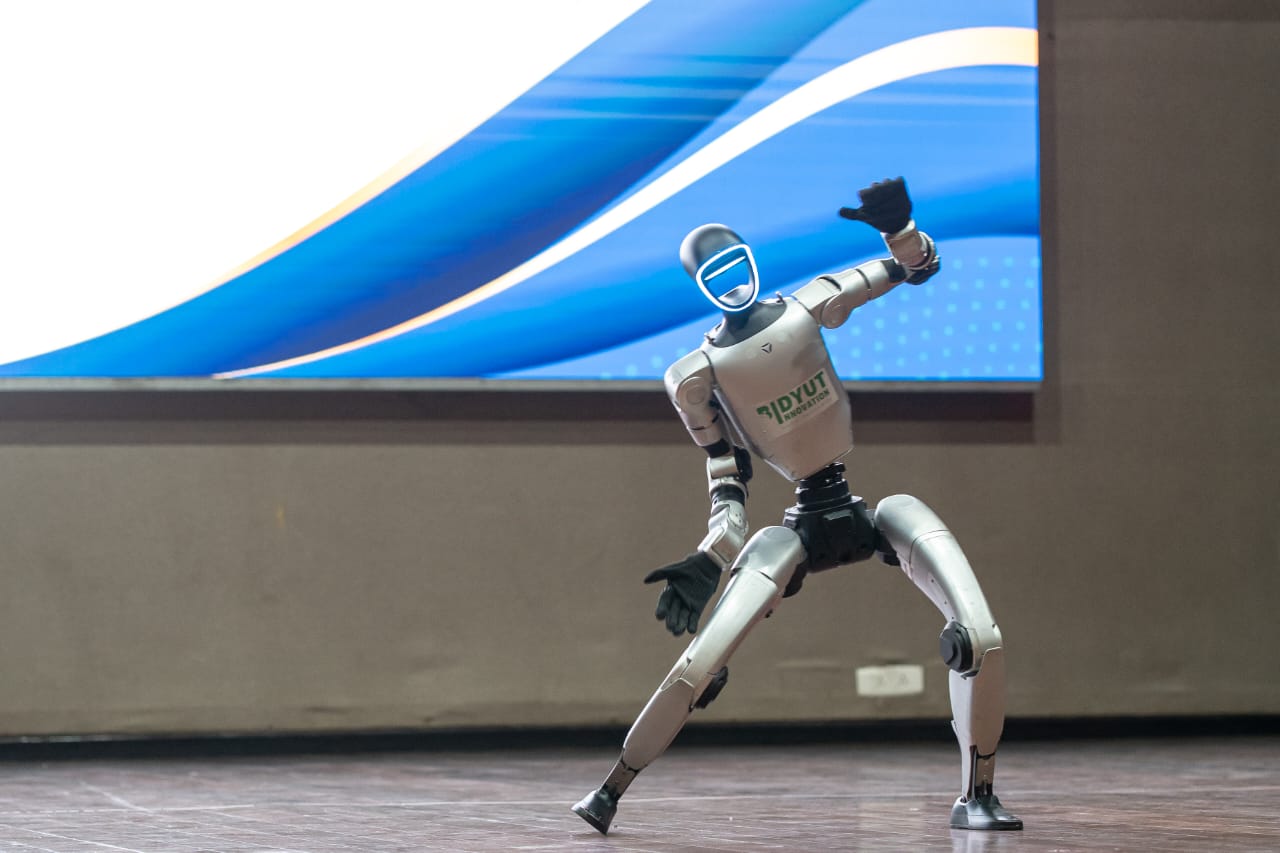
Google DeepMind has released Gemini Robotics 2.5, an AI model built to control robots. In a pilot at Mercedes-Benz factories, a humanoid robot using it sorted metal car brackets with a 96% success rate. In lab tests, robots using it also tied a bow on a gift box and served food with tongs.
What it is
Google calls it a vision-language-action model. In plain terms, it lets a robot look at its surroundings, understand an instruction in words, and then move its hands and arms to do the job. Google says it is its most capable model of this kind so far.
The company tested it on more than 200 different tasks. Those included pipetting a liquid, which means moving small amounts of fluid with a lab tool. Google says the tasks need advanced tool use, handling soft items like ribbon, and a gentle touch with delicate objects.
How much better it is
Compared with earlier baselines, Google says the model succeeds 30% to 100% more often, depending on the task. It also finishes tasks 20% to 30% faster. These figures come from Google's own evaluations, not an outside review.
The Mercedes-Benz test
Google worked with Apptronik and Mercedes-Benz. Apollo 2 humanoid robots ran on active production lines in Kecskemét, Hungary, and Sindelfingen, Germany.
The job was automotive kitting. That means pulling individual parts from bulk bins and placing them in trays in the exact order each vehicle needs. The robot reached into bins, picked up brackets and placed them in sequencing containers, correcting for gaps along the way. Google calls this a proof-of-concept. The goal is to free technicians from repetitive prep work so they can focus on more complex build tasks.
Apptronik said the models improved a lot in just a few weeks of extra training and carried over to the Mercedes-Benz production lines with very little drop-off.
Safety claims
Google says new guidance lets the robot steer around physical hazards in real time. In its tests, safe task completion rose 33% around obstacles and 43% around nearby people.
Google also reports that its Gemini 4 Argon model resisted 99.5% of attempts to trick it into unsafe requests, up from 82% for an earlier model. It released an open-source test set, called ASIMOV-Jailbreak, for others to run the same checks.
What is not known yet
The model is rolling out to Google's robotics partners. The material does not give a price, a date for wider access, or any plan for sale to the general public. It also does not say how many robots would be used in factories, or how the 96% rate compares with human workers.
- It works with Apptronik's Apollo 2 humanoid and the Franka Duo platform.
- The Mercedes-Benz work is a pilot, not a full rollout.
- Results are reported by Google and its partners.
The takeawayGoogle's new robot model shows strong early results in a real car factory pilot, but it is limited to partners for now and the numbers are self-reported.