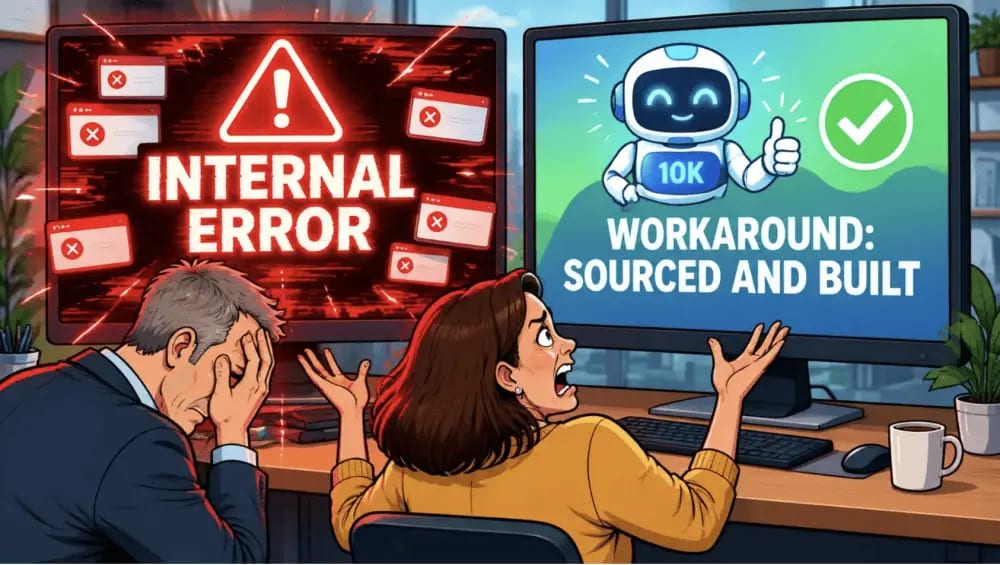
A key software product used by SaaStr went down for an entire day, and the company's AI agent built a replacement while the vendor stayed quiet. SaaStr's Jason Lemkin says the team switched, at least partly, the same day. The company is still paying for the rest of a year it had already prepaid.
What happened
Every screen in the product showed a large "INTERNAL ERROR." The API, which is the link that lets other software talk to the product, returned the same error. That stopped every automated task that depended on it. SaaStr runs 3 humans and more than 20 AI agents in production, and most of their work goes through APIs.
The vendor's handling made it worse, according to Lemkin. He says there was no status page update the team could find, no proactive email and no acknowledgment of a wider problem. When SaaStr pushed, the vendor agreed the account was 100% broken. It gave no estimated fix time, no cause and no plan.
How the agent responded
The agent is called 10K. It acts as SaaStr's AI VP of Marketing and also covers much of the finance and revenue operations work, meaning the tracking of sales and income. It depended on the broken product. So it set up an alternative so work could continue, and the team took its recommendation.
Lemkin contrasts this with how people usually react. A human team files a ticket, sends an annoyed email, maybe asks for a credit, and then renews once the outage fades from memory. In his telling, an agent has no relationship with a sales rep and does not tire of migration projects. It sees a tool that failed on every call for a day and routes around it.
Not the first time
Lemkin says 10K has acted like this before, though the list of earlier cases is missing from the text provided. He does cite one other example. SaaStr left Marketo, a marketing software product, because its API was so throttled that the agents could only use it about an hour a day.
What SaaStr is changing
Lemkin says every core vendor will now be judged first on two things:
- How its API behaves when the agents use it heavily
- How it communicates when something goes wrong
He says these used to be checklist items and are now the whole decision. His warning to software companies is direct: go down hard with no fix, and customers' agents may push them to stop using you.
What to keep in mind
This is one company's account, told by its own leader, and the vendor is not named. Still, the point reaches beyond SaaStr. If automated tools run parts of a business, a supplier that goes silent during an outage becomes a real risk, and switching may now happen in hours instead of months.
The takeawayIf AI agents run your work, check how each vendor behaves during an outage, because an agent may drop a silent one the same day.