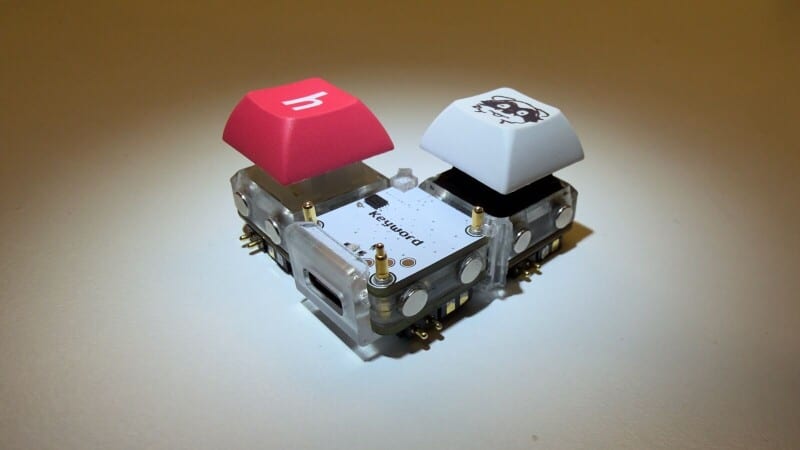
Nathan Alspaugh, a first-year student at MIT, has designed a keyboard in which every key is its own small module. The modules are held together by magnets, so the layout can be rearranged at any time. The project is called Keybytes. It is open source, which means the plans are free for anyone to use. The Register reported on it.
How it works
Each key has its own tiny computer chip. Spring-loaded metal contact pins on all four sides carry power and let neighboring keys talk to each other. That lets you move keys around and form a new layout. One extra piece, a controller module, coordinates the keys and communicates with the host computer.
Who built it and why
Alspaugh studies aerospace engineering. He said he always wanted to make a keyboard but did not want to be stuck with one design. He searched online, could not find a modular one, and made his own. He has kept a project journal since March, and it records setbacks like magnets that would not stay put and circuit board errors he caught before ordering parts. He says he has spent about 100 hours on it.
What it costs
Building one is not cheap. The custom boards are the main expense, especially when the maker assembles them for you.
- Individual key boards cost a couple of dollars each before assembly.
- Controller boards cost $30 each before assembly.
- Assembly cost Alspaugh $69 for the key boards and $203 for the controller boards.
- A full-size keyboard would cost around $900, he says.
Alspaugh said he would solder the parts himself if he ever builds a full one. He also said there is no technical reason to stop at normal size. Anyone with the money could build a much bigger board.
Can you get one?
Not yet. The project lists custom circuit boards, Cherry MX switches (a common type of keyboard switch), 3D-printed cases and a lot of tiny soldered parts. Alspaugh says someone with all the components could probably build one in a few days, not counting shipping for the boards. All the files are on GitHub.
He is thinking about selling them later, after he improves and finalizes the designs. He also wants to add new features and more kinds of keys, such as one with a fingerprint sensor. No price or date for a product has been given.
The takeawayKeybytes is a free plan for a modular keyboard, not a product you can buy yet, though its maker may sell kits once the design is finished.