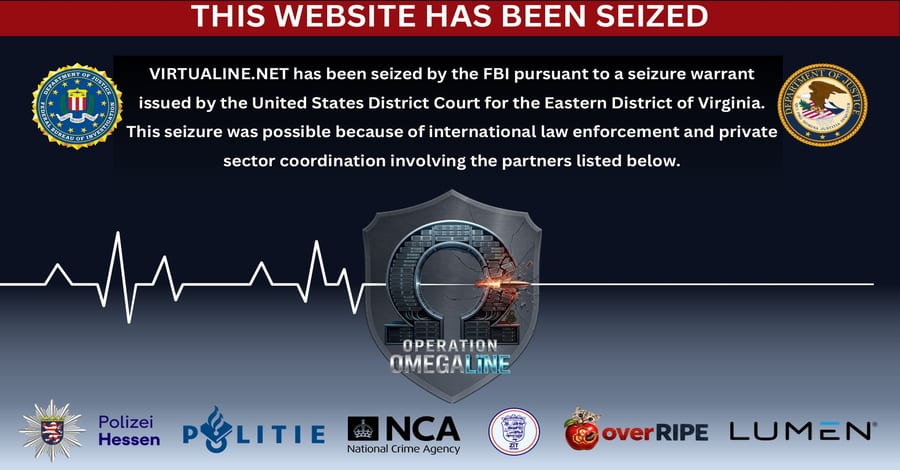
The FBI has seized the website of Virtualine, a company that rented web servers to criminals, the U.S. Justice Department said on Tuesday. Officials say the company knowingly hosted a site selling sexual images of minors and helped customers pay without being flagged as criminals. The operator denies the claims.
What Virtualine sold
Virtualine was a so-called bulletproof hosting provider. That means a web host that markets itself to criminals and promises to look the other way. Court documents say it also operated as Secury, Massgod, Spamhouse, Lanedo and Omegatech. It advertised on cybercrime forums for phishing, carding, email spam and port scanning, while ruling out child content and terrorism.
Plans ran from $19.99 a month for a basic server to $379.99 a month for higher-end ones. In June 2025, the provider allegedly boasted that it ignored more abuse than a customer's last three therapists. This March, it began selling a plan that would move customers' criminal setups to a shell company if police came calling.
What officials allege
The Justice Department says Virtualine hosted a criminal forum called Vendor 1 in court records. Vendor 1 allegedly sold access to explicit images of minors and adults. It also promoted a hack-for-hire service to break into victims' accounts and steal private images.
Virtualine got notices about the site starting in January 2026, officials say. They came from police in Germany, Canada and Australia, from the National Center for Missing and Exploited Children, and from a victim's attorney. The Justice Department says Virtualine kept hosting the site and helped build a new one for selling content. It says that site is still hosted by Virtualine.
The money trail
Virtualine took Bitcoin through special addresses labeled NO-AML, which let customers pay without worrying that funds would be flagged as illicit. The Justice Department says some of that money traced to criminal groups and was then laundered. Chainalysis, a firm that tracks Bitcoin, says the payments linked to ransomware operators, scam and phishing addresses, and other cybercrime.
The operator's response and what is unclear
After the seizure, the operator posted an open letter denying that Virtualine knowingly hosted child abuse material. The operator says requests were handled within 24 hours, that the Vendor 1 customer was cut off, and that customer data is safe. These are allegations, and the material does not mention any charges.
Takedowns may not end the problem. Silent Push, a security firm, noted that losing a network identifier does not mean a bulletproof host has stopped, since new ones can be obtained quickly. Spamhaus said last September that Virtualine kept getting new internet addresses.
What it means for you
Hosts like this help power the scams, phishing emails and leaked private images that reach ordinary people. Pulling one offline can cut off some of that supply. Readers need to take no action, but this is a reminder to stay wary of unexpected messages.
The takeawayOne shady host is down, but experts warn that similar services can reappear quickly, so scam and phishing caution still matters.