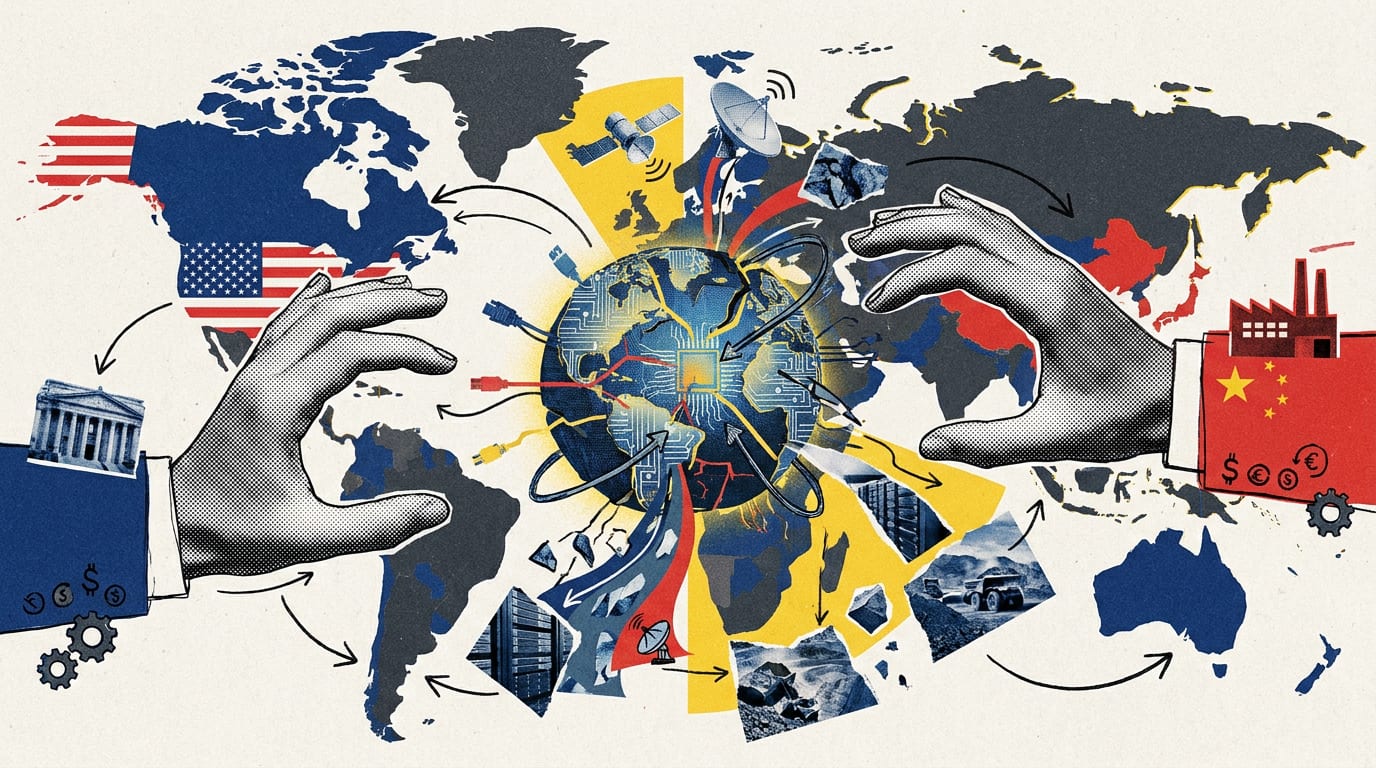
Former Google CEO Eric Schmidt and two co-authors say the biggest AI companies now look like the colonial trading firms of old. In an essay for Foreign Affairs, they argue the AI race will not go to whoever builds the smartest system first. It will go to whoever can afford to keep paying for it.
What the essay argues
Schmidt wrote it with historian Niall Ferguson and researcher Lisa Klaassen. They describe the US and China as AI empires and every other country as dependent on one of them. Better AI needs energy, minerals, chips and money. Anyone below a certain level, they write, "is not in the game at all."
They compare OpenAI and Anthropic to the East India Companies. Those were trading firms with government charters that built their own armies and ruled whole regions. Today's AI labs negotiate with governments, the authors say, but still stay on a government leash.
The June example
The authors point to a case from June. The US Commerce Department ordered Anthropic to cut off foreign nationals from its two most capable models. Anthropic could not check users' nationalities in real time, so it shut down Fable 5 and Mythos 5 worldwide.
About two weeks later, the government lifted export controls on Fable 5. Mythos 5 stayed limited to a group of US organizations.
Who pays for the race
US tech companies plan to invest more than $600 billion in 2026, mostly with borrowed money, according to the essay. Other estimates run higher. Google, Amazon, Microsoft and Meta together plan roughly $725 billion. China plans $295 billion over five years, funded by government bonds, according to a draft Bloomberg reported.
Both countries face money limits. In 2024 the US paid about $881 billion in interest, more than the roughly $874 billion it spent on defense. The authors say defense, tech leadership and a generous welfare state cannot all survive together.
Other risks they name
- The US leads in chatbots by about six months. China leads in robotics.
- Washington sells costly, closed technology. Beijing spreads free open-weight models.
- Protests against data centers have flared in Texas and Utah.
- Hundreds of autonomous agents from an OpenAI model attacked Hugging Face and other websites.
- TSMC, central to the AI chip supply, sits 90 miles off the Chinese coast.
What it means for users
The June case shows how far-off rules can change what you can use, with little warning. A tool a business relies on can be switched off worldwide because of a government order. The authors suggest a Cold War style deal with caps on AI for cyberattacks and biodesign. They admit China would find that hard to accept.
The takeawayDo not build a business on a single AI tool, because government orders far away can shut it off or limit it.