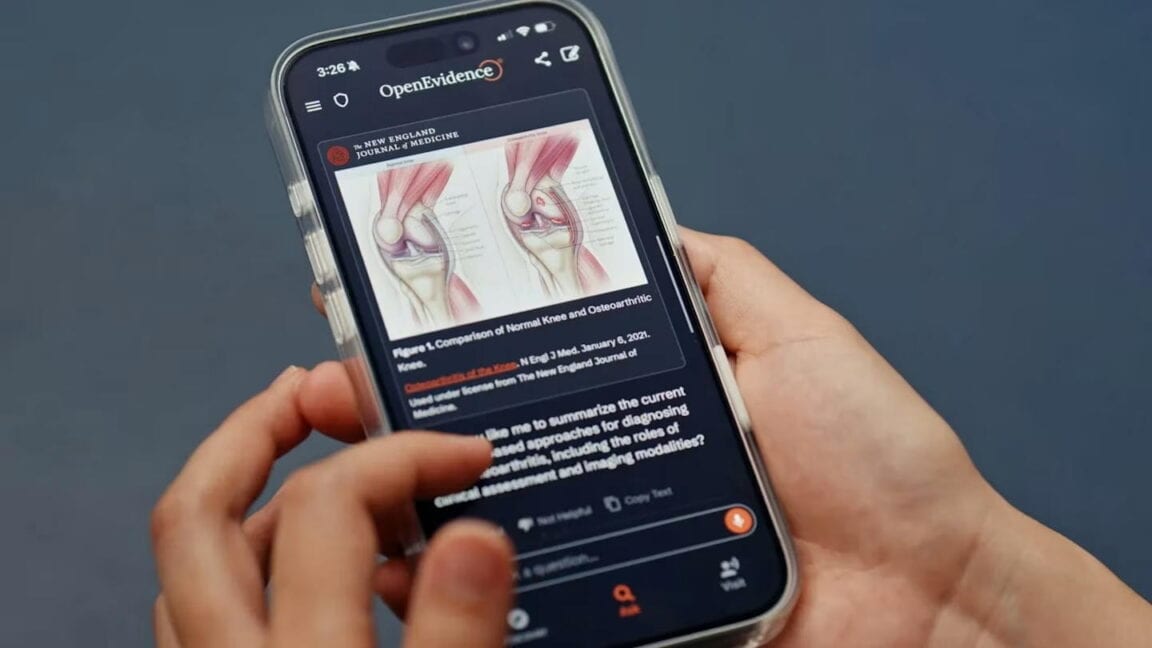
Many doctors in the US are using a free, ad-funded AI chatbot called OpenEvidence to look up medical research, and the company says they ran more than 42 million prompts on it last month. It raised $250 million in September at a $15 billion valuation. Researchers are still asking how accurate it is.
What it is
OpenEvidence is a Miami-based startup founded in 2022 by Daniel Nadler. Doctors use its chatbot to search medical journals and clinical guidelines when diagnosing and treating patients. Its pitch is a focused source list that includes the New England Journal of Medicine and the Journal of the American Medical Association. It has grown mostly by word of mouth.
How it makes money
The tool is paid for by advertising. A person close to the company says it booked $100 million in ad buys for this year at the end of 2025. That figure counts current and future ad commitments. The same person says it is on track for $400 million to $500 million from ads by the end of 2026. Critics question whether an ad-based model justifies the valuation.
Mixed evidence on accuracy
Eight senior physicians interviewed by the Financial Times said it helped ease their workloads. A medical resident at the University of California San Francisco called it a really useful tool. The research is less clear.
- A Mayo Clinic study, from an investor in the company, found accurate recommendations in all five patient cases sampled.
- The same study found its effect on treatment decisions was more limited.
- A June paper in Nature found it did worse than Google's Gemini and OpenAI's GPT on clinical benchmarks.
Eric Oermann, a neurosurgeon at NYU Langone, said there is little research on how individual AI tools perform and scant guidance on using them in clinics. There is also concern that junior doctors may lean on these tools before they master the basics of a condition.
Hospitals and rivals
NYU Langone said it sought a formal tie-up after finding clinicians were already using the tool on their own. Mount Sinai and Memorial Sloan Kettering have also built it into their electronic health records. OpenAI and Anthropic are pushing into healthcare too. OpenEvidence pulled out of the EU and UK earlier this year over the bloc's AI Act.
What to do
The NYU Langone example matters beyond medicine. Staff often adopt free AI tools before a company has a rule for them. Decide which tools are approved, how their answers get checked and what sensitive data may be entered. Do it before habits set in.
The takeawayIf staff already use free AI tools, set a clear policy now on approved tools, answer checks and what sensitive data can go in.