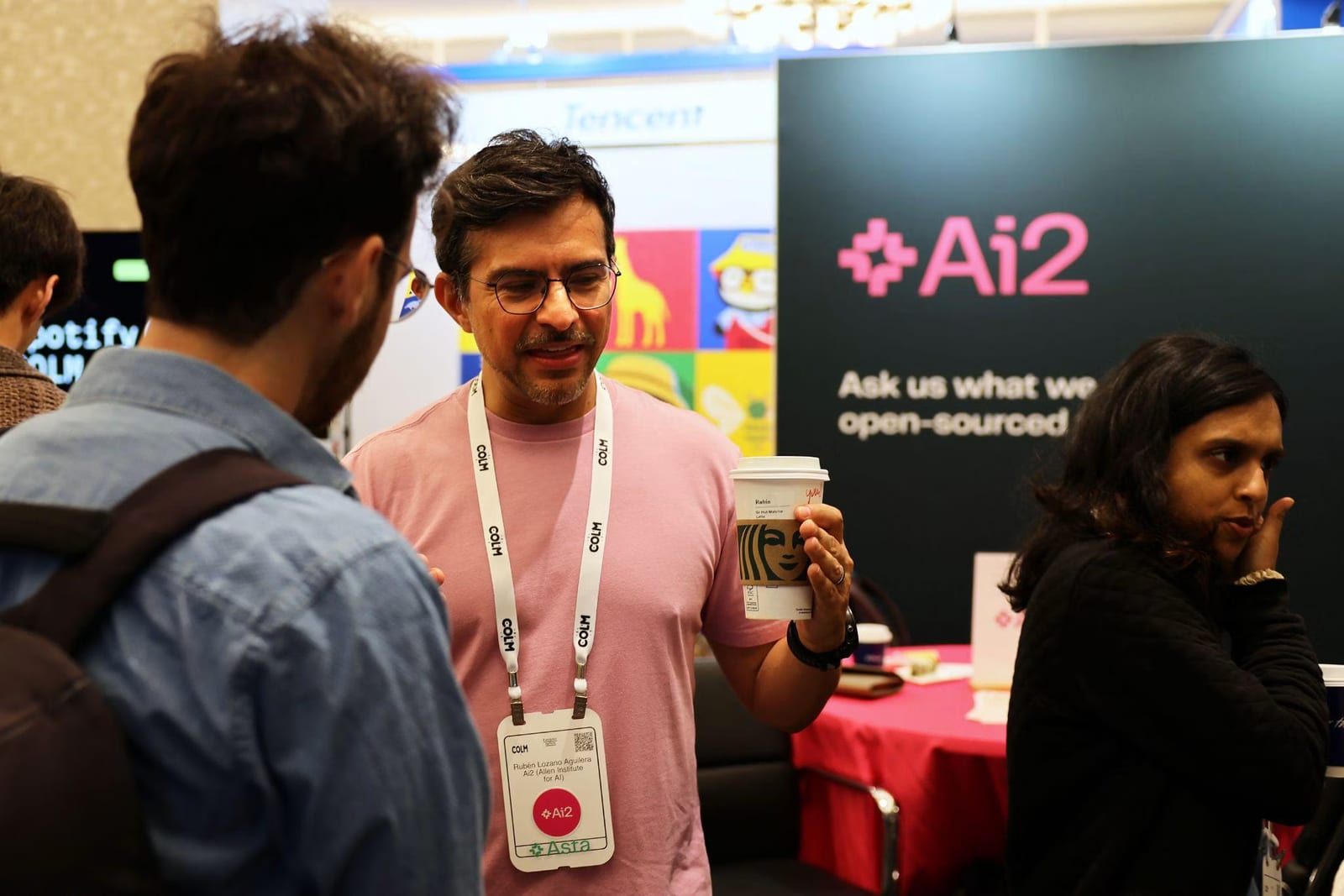
Ai2, a nonprofit AI lab, told the COLM 2026 conference in San Francisco that its new Olmo Hybrid design matched the score of its earlier Olmo 3 7B model on a well-known knowledge test. It did so with 49% fewer training tokens. Tokens are the small chunks of text a model reads while it learns. Less reading generally means less computing.
What changed
Olmo Hybrid mixes two ideas. Attention lets a model look back and pull out specific details from earlier text. Recurrent layers keep a compact running summary that updates as the text goes by. The test was MMLU, a benchmark covering knowledge across many subjects. Ai2 calls the result evidence that combining the two can improve training efficiency. The paper is titled "Olmo Hybrid: From Theory to Practice and Back."
Open, and repeated by others
Ai2 shares its models, data, code and methods so others can check the work. Olmo-core 3, released ahead of the conference, adds a redesigned system for training large mixture-of-experts models. That design sends each token through only some of a model's parts. Google also announced it recreated the Olmo 3 7B training run on its own Google Cloud chips. Ai2 points to that as proof of what an open approach allows.
Other releases
- AstaBrief is an open-weights model that writes cited reports from research questions and retrieved papers.
- Open-weights means the model files can be downloaded and run on your own servers.
- Bolmo, described in a paper in Nature, reads raw bytes instead of fixed chunks of text.
- The next Olmo model is in pre-training with a hybrid mixture-of-experts design.
What is not known yet
The material gives no release date for the next Olmo model. It does not say how much money the smaller training budget would save. It also does not say whether the 49% figure holds on other tests or at larger model sizes. The number comes from Ai2's own study.
Who it affects
Most readers will never train a model. Still, open models that need less training make cheaper, self-hosted AI more realistic for small businesses. Running a model on your own servers can keep sensitive documents in-house. Efficiency gains like this one are what could bring that option within reach.
The takeawayOpen models that learn with less data could make self-hosted AI cheaper, but the 49% result is one test from Ai2's own study.