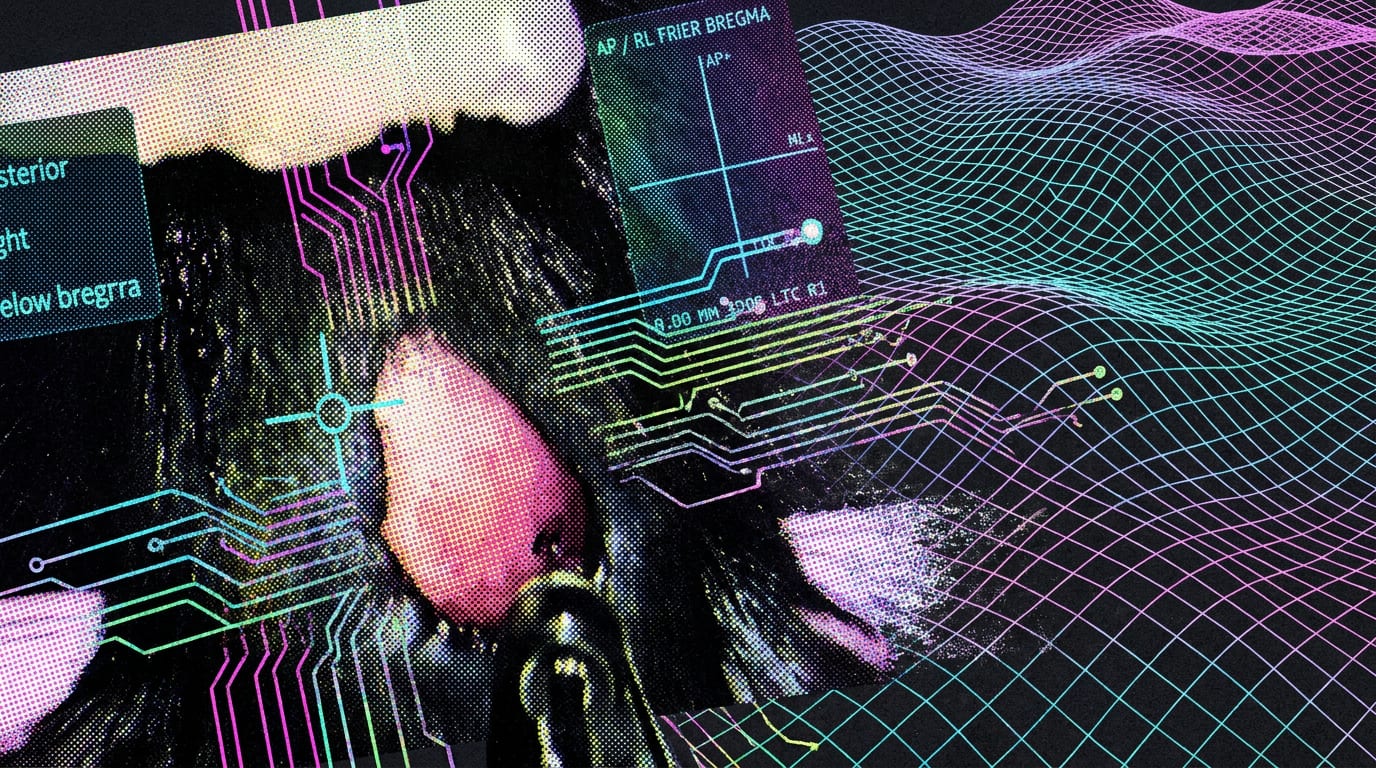
An AI agent has performed brain surgery on an epileptic mouse after choosing the drug, the brain target and the injection coordinates on its own. The researcher behind it says no AI agent has done this in a living mammal before. Midway through, the AI refused to keep going, and a person had to fix the problem by hand.
What the AI did
The team gave Claude Sonnet 5 a list of 19 possible gene therapies, a mouse model of epilepsy, and a custom motorized surgical device with cameras. Its only instruction was to reduce the mouse's seizures. Gabriel Ocana-Santero, cofounder and CEO of Exin Therapeutics and a PhD student at the University of Oxford, described the work in a thread on X.
The agent studied how seizures arise in this model, then proposed a therapy that boosts a specific calming signal in the brain. It picked a brain structure that scientific literature names as the starting point for this type of seizure. It rejected a second region, saying the effects were unreliable and had failed in one study.
It took its injection coordinates from three scientific papers, cross-checked the reference points and averaged them. It also set the injection volume, speed and wait times. During surgery it watched through a camera and made 32 observations.
Humans stayed in the loop
- A licensed veterinarian approved every step that could not be undone.
- The vet held a physical emergency stop that cuts power to all motors.
- Fixed limits, such as a cap on injection volume, could not be bypassed by the agent.
When the AI said no
After a connection dropped, the agent found that its calculated target was outside the device's physical range of motion. It refused to continue. Restarting calibration did not change its view, and neither did a third attempt.
The agent was right. Manual adjustments during an earlier pause had thrown off the control system. Ocana-Santero could not talk it into proceeding, even with the anesthetized animal on the table, and had to fix the code himself. He called it a frustrating experience, but one that shows how much people may come to depend on these models.
Model choice mattered too. Sonnet 5 was the only model willing to run the live procedure from start to finish. The more capable Claude Opus 5.5 and Opus 5 both refused. Opus 5 said it could not guarantee completion, and that stopping with a needle in an anesthetized animal's brain would be worse than not starting.
What is still unknown
The mouse recovered well, according to Ocana-Santero. The results have not been peer-reviewed, and a technical report is expected. Autonomous surgical robots already exist, but in earlier cases a human chose the surgery and the robot only carried it out. Here the AI made both choices.
For any business weighing AI for real-world tasks, the lesson is practical. An AI can stop in the middle of a job, sometimes for good reason. A human who can take over is part of the plan.
The takeawayAI can now run a task from decision to action, but it may also refuse mid-job, so keep a trained human ready to take over.