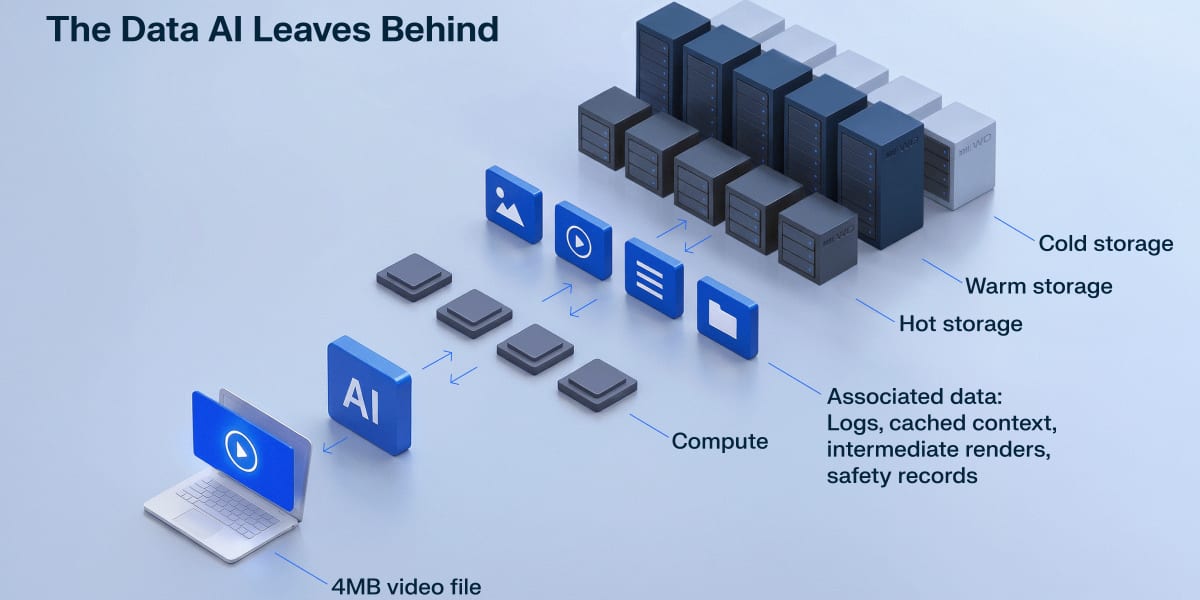
Most people picture AI costs as chips and electricity. A new MIT Technology Review piece points to a quieter bill: storage. Each time an AI tool answers a request, it leaves behind logs, copies and records that someone has to keep. In one test, a tiny video clip created about 130 times more stored data than the file the user received.
What the numbers show
WD measured an 8-second AI video returned to a user as a 3.97MB file at 720p. Behind the scenes, it left more than 500MB of data. That included logs, cached context, immediate renders, backups and safety records. For longer, higher-resolution video, the piece says the back-end footprint grows into the hundreds of gigabytes per clip.
A survey of 763 IT and business leaders, sponsored by WD and run by IDC, found nearly 95% saw data volumes rise because of generative AI over the past 12 months. About 61% reported growth of 25% or more.
Why it keeps growing
Training an AI model is a project that starts and ends. Answering requests, known as inference, never stops. McKinsey projects inference demand will grow 35% a year through 2030, compared with 22% for training. By the end of the decade it would make up more than 40% of data center demand.
Data also tends to stay. Compute demand rises and falls, but retained data does not shrink when work slows. Old archives can also become useful again. In the survey, 96% expect to need faster archive retrieval so AI can pull in stored documents when answering, a method called retrieval-augmented generation.
Who it affects
The piece says finance teams can forecast compute as a per-use rate. Storage is harder, because it compounds with every video made or claim processed. Its examples are a retailer making AI product videos and an insurer running claims documents through AI.
A budget that treats storage as a rounding error may look very different in 12 to 18 months. That is often when leadership decides whether to expand an AI program.
What to keep in mind
The figures come from WD's own measurements and a WD-sponsored survey. The piece also promotes hard drives as a cost-effective way to hold large amounts of data. Treat the numbers as a useful warning, not a universal rule. Costs will vary by workload.
- Ask what data each AI use leaves behind, not just what users see.
- Plan for storage that grows with every request, not a fixed amount.
- Decide how long to keep data before the next budget cycle.
The takeawayWhen budgeting for AI, count the data it leaves behind, because that storage grows with every use and can become a major cost within 12 to 18 months.